Community Overview

Exploring Our Community

Where Texas Began, and Where Your Next Chapter Starts

Flying into the region, you will look down on a landscape that looks nothing like the flat, featureless terrain many people associate with Texas. Washington County unfolds below in gentle rolling hills blanketed with post oak forests, open pastures, and rich farmland, all threaded by creeks winding toward the Brazos River. In spring, those hills turn a striking blue and red as bluebonnets and Indian paintbrushes bloom across thousands of acres. This is the heart of wildflower country, and it is the landscape you will call home.

Brenham sits in east-central Texas along U.S. Highway 290, positioned almost exactly halfway between Houston and Austin. The city is the county seat of Washington County, a region formally recognized as the "Birthplace of Texas" because the Texas Declaration of Independence was signed at nearby Washington-on-the-Brazos in 1836. That history is visible everywhere here, from the state historic site just minutes outside town to the preserved Victorian homes and brick-lined streets of downtown Brenham. This is a community with deep roots and a clear identity.

  • Population: Approximately 18,000 residents, with steady growth over the past decade
  • County seat of Washington County, the site where Texas declared independence from Mexico
  • U.S. Highway 290 and State Highway 36 provide direct connectivity to Houston and Austin
  • Niche.com ranks Brenham among the best places to live in Texas and among the most diverse small towns in the country
  • Named one of the five best small towns in Texas by multiple publications, recognized for affordability, cultural heritage, and quality of life

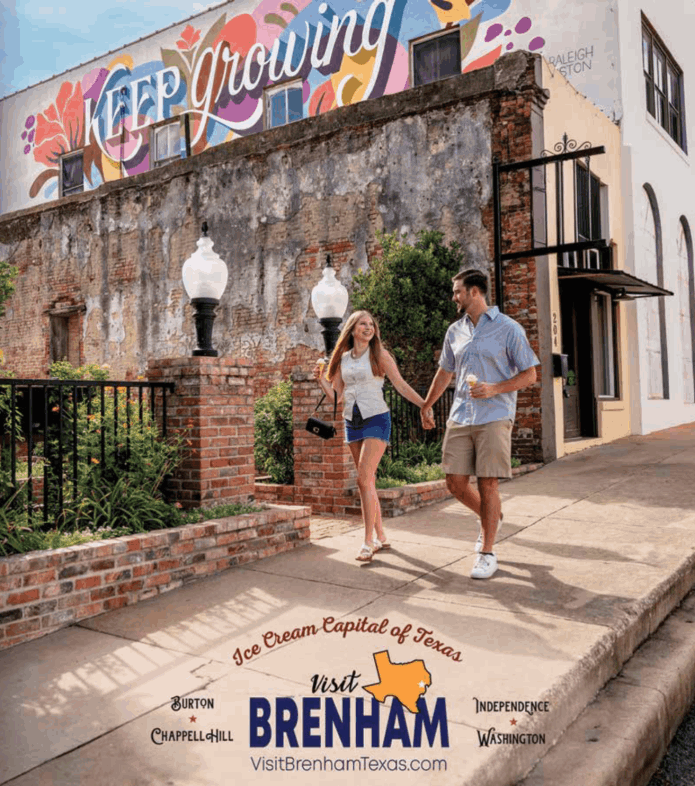
The Ice Cream Capital of Texas

Brenham is home to Blue Bell Creameries, one of the largest ice cream producers in the United States. Founded in 1907 as a small butter creamery, Blue Bell has grown into a nationally distributed brand while keeping its headquarters and primary production facility right here in Brenham. The company remains family-owned by the Kruse family, which has led operations since 1919.

Locals take genuine pride in Blue Bell; it is part of the town's fabric, and you will find its story on murals downtown, on restaurant dessert menus, and in conversation with nearly anyone you meet. The Blue Bell Visitor Center and Ice Cream Parlor are open to the public and draw visitors year-round.

Beyond Blue Bell, the town carries a second identity. Brenham is known as "The Baseball Capital of Texas." The Brenham Cubs baseball program has reached the state championship 15 times and won it seven times, one of only three programs in the state with that track record. Hohlt Park and Fireman's Field host games throughout the season, and you will notice quickly that high school sports carry real weight in this community.

  • Blue Bell Creameries produces ice cream distributed across more than 20 states from its Brenham facility
  • Brenham Municipal Airport (11R) serves general and private aviation
  • "The World's Largest BBQ Pit" sits on US 290 West at the edge of town
  • Maifest, an annual German heritage festival dating back to 1874, is one of the oldest festivals in the state
  • Over 40 bed and breakfasts operate in Washington County, drawing visitors from Houston, Austin, and beyond

Location and Access

One of Brenham's strongest advantages is its position between two major metro areas without the traffic, cost, or congestion that comes with living in either one. You can drive to downtown Houston in roughly 1 hour and 15 minutes. Austin is about 1 hour and 30 minutes to the west. College Station, home to Texas A&M University, is approximately 45 minutes north.

That means you have access to professional sports, world-class dining, major medical centers, and international airports without sacrificing the pace and character of small-town living.

For air travel, George Bush Intercontinental Airport (IAH) in Houston offers nonstop flights to destinations across North America, Europe, Latin America, and Asia. Austin-Bergstrom International Airport (AUS) provides similar domestic and international service. Easterwood Airport (CLL) in College Station handles regional commercial flights and is the closest commercial option.

When your family or friends want to visit, they can fly into either major hub and make the scenic drive to Brenham in well under two hours.

  • Houston (IAH): 74 miles, approximately 1 hour 15 minutes
  • Austin (AUS): 89 miles, approximately 1 hour 30 minutes
  • College Station (CLL): approximately 45 minutes
  • San Antonio: approximately 2 hours 30 minutes
  • Dallas/Fort Worth: approximately 3 hours 15 minutes

Climate and Seasons

Brenham has a humid subtropical climate with four distinct seasons, though winters are short and mild compared to most of the country. You will experience approximately 2,840 hours of sunshine per year. Summers are warm, with average highs reaching the mid-90s in July and August, and the humidity is noticeable.

But fall arrives with cooler mornings and comfortable afternoons, and winters rarely bring temperatures below freezing for extended periods. January averages a high of 59°F and a low of 43°F. Snow is rare, accumulating less than an inch in a typical year.

Spring is the standout season. From late March through mid-April, the countryside surrounding Brenham becomes one of the most popular wildflower viewing destinations in Texas. Fields of bluebonnets stretch for miles along farm roads, attracting photographers and families from across the state. The nearby town of Chappell Hill hosts the Official Bluebonnet Festival of Texas each April. If you enjoy spending time outdoors, you will find that Brenham's climate supports year-round activity, with only the peak summer months requiring some adjustment.

  • Average annual sunshine: approximately 2,840 hours
  • Average annual precipitation: approximately 39 inches, with May being the wettest month
  • Average summer highs: 90°F to 95°F (June through August)
  • Average winter highs: 59°F to 63°F (December through February)
  • Peak wildflower season: late March through mid-April
  • Annual snowfall: less than 1 inch in a typical year

Why People Choose Brenham

The people who relocate to Brenham do so because they want a different kind of life than what large metro areas offer. They want to live in a place where their commute is measured in minutes, where their children can play outside without worry, and where they can build real relationships with neighbors who know their names. They also want access to everything a major city provides without having to live inside one. Brenham delivers on all of those points.

You will find a walkable downtown with brick-lined streets, colorful murals, boutique shops, a professional theater (Unity Theatre), craft breweries, and restaurants that draw people from Houston and Austin specifically to eat here. Truth BBQ, which started in Brenham before expanding to Houston, is a destination in its own right.

The Barnhill Center at the Historic Simon Theatre, the Brenham Heritage Museum, and the Flying Horses Antique Carousel in Fireman's Park add layers of character that newer suburban communities simply cannot replicate. The Washington County Courthouse anchors the town square, and events like Hot Nights Cool Tunes summer concerts and the annual Christmas Stroll bring the community together throughout the year.

This is a real Texas town with a real identity. It has a story, a personality, and a pace that rewards the people who choose it.

  • Walkable, National Register-listed downtown with murals, boutiques, restaurants, and live theater
  • Four wineries operate in Washington County
  • Washington-on-the-Brazos State Historic Site sits just minutes from town
  • Lake Somerville offers boating, fishing, hiking, and camping within a short drive
  • Antique Rose Emporium features 8 acres of display gardens
  • Cost of living approximately 18% below the national average, with no state income tax
Your Ultimate Travel Guide

Looking to explore a new destination, but not sure where to start? A travel guide can help you discover the hidden gems and must-see attractions of a new place. Whether you're looking for the best local cuisine, the most scenic views, or the most exciting activities, a good travel guide can provide you with insider knowledge and expert recommendations. With a travel guide in hand, you can make the most of your trip and experience a new place like a local. So why not start planning your next adventure with a travel guide today?

History Unveiled: A Journey Through Time

Before There Was a Texas

The land that would become Washington County has been inhabited for thousands of years. Archaeological evidence, including Paleo-Indian artifacts, suggests human presence in the region stretching back roughly 9,000 years. By the time European explorers arrived, the area between the Brazos River and the rolling prairies was home to Tonkawa peoples living in permanent settlements, along with transient bands of Apache and other groups moving through the region.

The French expeditions led by La Salle in the late 1680s were likely the first European crossings of what is now Washington County, and the Spanish later built a road through the area to connect their presidio near Nacogdoches with the mission at Goliad.

The region opened to organized Anglo-American settlement in 1821 when Stephen F. Austin received permission from the Mexican government to bring colonists into Texas. The settlers who came were part of the "Old Three Hundred," the first authorized colonization by Anglo-Americans, and many of them took advantage of generous Mexican land grants in the fertile Brazos River valley.

Small communities began forming in the 1820s and 1830s, drawn by the rich soil, abundant timber, and access to the Brazos for transportation. These early settlers were farmers and traders who recognized the agricultural potential of the gently rolling countryside.

  • The Brazos River valley offered fertile bottomland ideal for cotton, corn, and livestock
  • Stephen F. Austin's colony brought the first organized wave of Anglo-American settlers in the 1820s
  • Steamboat traffic on the Brazos connected early farmers to markets in Houston and Galveston
  • Washington County was formally established in 1836

The Birthplace of Texas

On March 2, 1836, a delegation of 59 men gathered at the small settlement of Washington-on-the-Brazos, just northeast of present-day Brenham, and drafted the Texas Declaration of Independence. In that single act, they declared Texas a free, sovereign, and independent republic, separating from Mexico.

The delegates also drafted a constitution and formed a provisional government. Washington-on-the-Brazos served as the capital of Texas in 1842 and remained a center of government until Texas was annexed by the United States in 1845 and the capital moved to Austin.

This is how Washington County earned its permanent designation as the "Birthplace of Texas", a title the community carries with visible pride. Today, the Washington-on-the-Brazos State Historic Site preserves the location where independence was declared.

The park includes a replica of Independence Hall, the Star of the Republic Museum, and the Barrington Living History Farm, where costumed interpreters portray daily life on the 1850s homestead of Anson Jones, the last president of the Republic of Texas. You can walk the interpretive trails along the Brazos River and stand on the same ground where Texas became a nation.

  • 59 delegates signed the Texas Declaration of Independence on March 2, 1836
  • Washington-on-the-Brazos served as the capital of Texas during 1842
  • The state historic site is located approximately 15 minutes from downtown Brenham
  • The Barrington Living History Farm recreates the homestead of Republic of Texas President Anson Jones
  • Texas Independence Day celebrations are held annually on the weekend nearest March 2

From Hickory Grove to County Seat

The community that became Brenham started as a small settlement called Hickory Grove. In 1843, residents renamed it in honor of Dr. Richard Fox Brenham, a Kentucky-born physician who had practiced medicine in Washington County before dying in 1843 during the Mier Expedition while serving in the Texian militia.

Historical accounts describe him as a man of considerable intelligence and generosity who was widely admired by the settlers, women, and children of the area.

On February 4, 1844, Washington County voters selected Brenham as the county seat, largely through the political efforts of Jabez D. Giddings and a 100-acre townsite donation from landowners Jesse Farral and James Hurt. A post office followed in 1846.

The town was formally incorporated in 1858, by which point it had become a rapidly growing supply center for the prosperous agricultural region surrounding it. Cotton was king, and the Brazos River valley produced it in abundance.

The Giddings family, particularly brothers J.D. and D.C. Giddings, played an outsized role in Brenham's early development. They advocated for incorporation, served in public offices, and in 1856 established the Washington County Railroad Company.

By 1860, they had completed a rail line connecting Brenham to Hempstead, giving local cotton growers and manufacturers direct access to markets in Houston and Galveston. During the Civil War, railroad construction across Texas halted, and for a decade the only sizable railroad towns in the state were Brenham, Houston, and Galveston.

That advantage made Brenham an economic center, with goods from Washington County shipped to the east coast and around the world.

  • Named for Dr. Richard Fox Brenham, a physician and Republic of Texas hero
  • Became the county seat of Washington County on February 4, 1844
  • Formally incorporated in 1858
  • The Washington County Railroad (1860) made Brenham a critical distribution point for the state's interior
  • During the Civil War, Brenham was one of only three railroad towns in Texas

The Burning of Brenham and the Fire Department

The most dramatic chapter of Brenham's history came during Reconstruction. After the Civil War, over 200 federal soldiers were stationed in Brenham to maintain order, and tensions between Union troops and local residents ran high. The local newspaper editor was arrested twice for his writings criticizing the occupation.

On the night of September 7, 1866, an altercation broke out between citizens and several Union soldiers at a dance being held to raise funds for a new school for freed Black citizens. The situation escalated into a gunfight on Main Street.

In retaliation, Union officers ordered their soldiers to ransack and loot downtown businesses. The soldiers, reportedly fueled by stolen whiskey, set fire to an entire city block, destroying a large portion of the town. A Texas Senate and House investigation later placed blame for the fire on the Union soldiers.

The Burning of Brenham became the defining event that shaped the city's civic identity. Determined to protect themselves, citizens formed the Hook and Ladder Company No. 1 in May 1867, electing D.C. Giddings as foreman.

On the surface, it was a fire company. In practice, it also served as an organized militia to defend the community during the remaining years of Reconstruction, which ended in 1874. The fire department then began building a network of public cisterns to collect rainwater for firefighting.

Over the next 20 years, at least 27 cisterns were constructed beneath the downtown streets. In 2000, a city road crew accidentally uncovered one of these cisterns during a street repair, leading to the creation of Toubin Park, a downtown interpretive space that tells the story of the fire and the cistern system.

The fire department purchased 14 acres in 1883 that became Fireman's Park. In 1879, it acquired a Silsby steam-pumper fire engine, only the second in Texas, which is now on display at the Brenham Fire Museum.

In 1881, the department organized the first annual Maifest, a spring festival celebrating the community's German heritage. That tradition continues today.

  • The Burning of Brenham occurred September 7, 1866, destroying a large portion of the town
  • The Brenham Fire Department was formed in May 1867, the first organized civic institution after the fire
  • At least 27 public cisterns were built beneath downtown streets for firefighting
  • Toubin Park in downtown Brenham tells the story through illustrated panels and a restored cistern
  • The 1879 Silsby steam-pumper fire engine, only the second in Texas, is displayed at the Brenham Fire Museum

Immigration, Growth, and Cultural Foundations

German immigrants began settling in Brenham as early as 1846, and their numbers grew steadily through the second half of the 19th century, peaking between 1880 and 1883. Many came in the wake of the failed revolutions in German states in 1848.

They brought with them agricultural expertise, a strong work ethic, and cultural traditions that remain part of Brenham's identity today, including the Maifest celebration and the establishment of churches like St. Paul's Evangelical Lutheran Church (1890) and the German Methodist Church (1873).

Jewish immigrants also played a significant role in Brenham's commercial development. Merchants like Alexander Simon, who arrived after the Civil War, opened dry goods stores and became leaders in the business community.

In 1885, Jewish residents founded B'nai Abraham, one of the first Orthodox synagogues in Texas. The Toubin family, Lithuanian immigrants who arrived in the early 1920s, eventually operated nine retail stores across south-central Texas.

The synagogue building, which looked like a rural Gothic church from the outside but was designed in the Orthodox fashion inside, stood in Brenham for over a century before being relocated to Austin in 2015.

Brenham also established itself as an educational leader. In 1875, the city organized the first tax-supported public school system in Texas, including a school for Black students.

Pickard High School, established around 1875, was the first high school in Texas for Black students. In 1883, German Methodists founded Mission Institute, which was later renamed Blinn Memorial College (now Blinn College) in recognition of financial support from Reverend Christian Blinn.

Today, Blinn College is the oldest county-owned junior college in Texas and maintains its main campus in Brenham.

  • German immigration peaked between 1880 and 1883, shaping the community's cultural identity
  • B'nai Abraham synagogue (1885) was one of the first Orthodox congregations in Texas
  • Jewish merchants were central to Brenham's retail and wholesale trade development
  • Brenham established the first tax-supported public school system in Texas (1875)
  • Pickard High School was the first high school for Black students in Texas
  • Blinn College, founded in 1883, is the oldest county-owned junior college in the state

Into the 20th Century and Beyond

Brenham's population doubled every decade between 1860 and 1900. By the 1890s, the economy had diversified to include cottonseed oil production, mattress manufacturing, food processing, and metal fabrication.

The Washington County State Bank, organized in 1905, became the oldest surviving state bank in Texas.

In 1907, the Brenham Creamery Company opened to purchase excess cream from local dairy farmers. By 1911, it began producing small quantities of ice cream. In 1919, a 23-year-old former schoolteacher named E.F. Kruse was hired to run the struggling company and refused to accept a salary during his first months so the company could avoid further debt.

Under his leadership, the creamery expanded production and in 1930 was renamed Blue Bell Creameries after Kruse's favorite wildflower. By 1970, Blue Bell had become the largest ice cream producer in Texas, and by the late 1980s it was generating over $100 million in annual sales.

The company remains family-owned by the Kruse family and is now one of the top-selling ice cream brands in the United States, with its headquarters still in Brenham.

The city continued to grow through the mid-20th century, supported by the Brenham Industrial Foundation (established 1953) and an influx of residents from both the Houston area and surrounding rural communities.

The Main Street Program renovated downtown Brenham in the late 20th century, restoring Victorian-era buildings and encouraging tourism. Several historic homes have been preserved, and downtown Brenham's National Register Historic District now features brick-lined streets, colorful murals, boutique shops, and restaurants that draw visitors from across the state.

Today, the city that started as a small frontier settlement called Hickory Grove has a population approaching 20,000 and a clear sense of who it is. The physical evidence of Brenham's history is everywhere: in Toubin Park's cistern, in the Flying Horses Carousel rescued from a field in 1932 and restored in Fireman's Park, in the 1915 Federal Post Office building that now houses the Brenham Heritage Museum, and in the massive 1940 Washington County Courthouse that anchors the town square.

When you drive through Washington County, you are driving through the place where Texas began, and the community has never stopped building on that foundation.

  • Blue Bell Creameries was founded in 1907 and remains headquartered in Brenham
  • The Brenham Heritage Museum is housed in a 1915 Classical Revival former post office
  • The Flying Horses Carousel, a C.W. Parker antique, was rescued in 1932 and restored in Fireman's Park
  • Downtown Brenham is listed on the National Register of Historic Places
  • The 1940 Washington County Courthouse continues to serve as the centerpiece of the town square
Population & Demographics: Understanding Our Diverse Community

A Growing Community Between Two Major Metros

Brenham's population has reached approximately 19,600 residents as of 2024, representing a 13% increase since the 2020 census count of 17,369. Washington County as a whole is home to roughly 37,600 people. The growth is steady rather than explosive, which means the community is expanding without losing the character that draws people here.

Unlike the rapid, sometimes chaotic sprawl of the Houston and Austin suburbs, Brenham is adding residents at a pace that allows infrastructure, schools, and services to keep up.

The city sits at the center of what the Texas Comptroller's office calls the "Texas Triangle," the region bounded by Houston, Austin, Dallas-Fort Worth, and San Antonio that contains roughly 75% of the state's population. This positioning gives Brenham access to a labor shed of over 210,000 workers within a 60-mile radius and a labor force population of 1.5 million within a 50-minute commute.

For a physician's spouse seeking professional employment, this geographic advantage is significant. You can live in a community of 20,000 and still access career opportunities across multiple metro areas.

  • City population: ~19,600 (2024 estimate); Washington County population: ~37,600
  • Brenham has grown 13% since 2020, outpacing many similarly sized Texas cities
  • Median age: 32.4 in Brenham; 40.9 countywide
  • The broader labor market within commuting distance includes over 1.5 million workers
  • College Station/Texas A&M University is 45 minutes north; Houston is 74 miles southeast; Austin is 89 miles northwest

Demographic Composition

Brenham is one of the more diverse small cities in Texas, a fact recognized by Niche.com's ranking of the community among the most diverse small towns in the state. The 2024 population estimates show a breakdown of approximately 46% White, 26% Black or African American, and 24% Hispanic or Latino, with smaller Asian (2.8%) and multiracial populations.

This diversity is rooted in the community's history: German and Czech settlers arrived in the mid-1800s, African American communities were established during and after Reconstruction, and Hispanic families have been part of the region for generations. More recently, immigrants from Central America and other regions have added to the mix.

Among households, 81.4% report speaking English as their primary language, while 15.4% report Spanish. Roughly 8.9% of residents are foreign-born. Self-reported ancestries in the city include German (15.3%), American (6.8%), Irish (4.8%), English (3.1%), and Polish (1.6%), reflecting the waves of immigration that shaped Washington County over nearly two centuries.

The diversity is not just statistical. It shows up in how the community celebrates. Maifest, the oldest festival in Texas (held annually since 1881), honors the German heritage with parades, coronations, and traditional food. The Juneteenth Heritage Celebration includes a downtown parade and events organized by the Washington County Juneteenth Association.

The Official Bluebonnet Festival of Texas in nearby Chappell Hill, the Washington County Fair (the oldest county fair in Texas), the Burton Cotton Gin Festival, and Texas Independence Day celebrations at Washington-on-the-Brazos each reflect different threads of the area's cultural fabric.

  • Racial/ethnic composition: ~46% White, ~26% Black, ~24% Hispanic, ~3% Asian and other
  • 15.4% of households are Spanish-speaking
  • German ancestry is the most commonly reported heritage (15.3%)
  • Annual cultural events span German, African American, Texan, and agricultural traditions
  • Niche.com ranks Brenham among the most diverse small towns in Texas

Income, Employment, and Economic Stability

Washington County's median household income is $75,085, which is close to the statewide median. Within the Brenham city limits, the median household income drops to approximately $57,207, a figure influenced by the college student population at Blinn College and the presence of state-supported residential facilities. Roughly 12% of Brenham households report incomes exceeding $150,000 annually.

The local economy is notably diversified. Unlike many small Texas communities that depend on a single industry, Brenham supports a mix of food manufacturing, insurance, higher education, healthcare, advanced manufacturing, and agriculture. The unemployment rate consistently runs around 2.8%, well below state and national averages.

Major employers in Washington County include:

  • Blue Bell Creameries (ice cream production, one of the top-selling brands in the U.S., headquartered in Brenham)
  • Brenham State Supported Living Center (200-acre state facility serving individuals with intellectual and developmental disabilities, one of the county's largest employers)
  • Germania Insurance Companies (state headquarters located in Brenham)
  • Blinn College (oldest county-owned junior college in Texas, with its main campus in Brenham)
  • Brenham Independent School District
  • Baylor Scott & White Medical Center, Brenham (25-bed critical access hospital)
  • Valmont Industries (metal pole manufacturing)
  • Tempur Sealy International (mattress manufacturing)
  • MIC Group (precision machining and manufacturing)
  • Emerson (industrial technology)
  • Del Sol Food Group (maker of BRIANNAS salad dressings)
  • RR Donnelley (commercial printing)
  • City of Brenham (200+ full-time employees; the city owns and operates all public utilities including electric and gas)

For a physician's spouse, employment options within Brenham include healthcare, education, insurance, and corporate positions at these companies. The proximity to Houston, Austin, and College Station/Texas A&M significantly expands professional opportunities. The average commute time in Washington County is 21.2 minutes, and many residents who work in the county enjoy commutes of 10 to 15 minutes.

Community Character

The people of Brenham carry a strong sense of local identity. Washington County's designation as the "Birthplace of Texas" is a point of genuine pride, and the community treats its heritage, institutions, and traditions with care.

Residents describe the atmosphere as family-oriented and neighborly, the kind of place where people wave from their cars, know their children's teachers by name, and show up for high school baseball games. The Brenham Cubs baseball program, with 15 state championship appearances and 7 titles, is a source of particular community pride.

The presence of Blinn College adds a youthful element to the population. Students from across the state enroll at Blinn, many using it as a pathway to Texas A&M University in nearby College Station. This steady flow of younger residents supports local restaurants, shops, and entertainment venues, and it creates a campus-town energy that distinguishes Brenham from many communities of similar size.

Brenham's parks system is a reflection of community values. The city maintains 298 acres of park space across eight parks, translating to 17.6 acres per 1,000 residents. That ratio is nearly double the Texas median (9 acres) and well above the national median (11.9 acres). Two of these parks, Fireman's Park and Henderson Park, have earned Lone Star Legacy Park designation, one of the highest honors bestowed on a Texas park.

The community is also church-oriented and tends to lean conservative politically. Newcomers who are active and open about getting involved generally report being welcomed into civic life, school organizations, and faith communities. The annual Maifest, which operates as a nonprofit 501(c)(3), reinvests festival proceeds into college scholarships, park restoration, and local charities.

  • Brenham Cubs baseball: 15 state championship appearances, 7 titles ("Baseball Capital of Texas")
  • Blinn College brings a campus-town element with students from across Texas
  • 298 acres of park space; 17.6 acres per 1,000 residents (nearly double the Texas median)
  • Two Lone Star Legacy Parks: Fireman's Park (designated 2014) and Henderson Park (designated 2022)
  • Strong civic culture built around schools, churches, and community traditions

When you practice medicine in Brenham, you will know your patients, and they will know you. The demographic mix means you will serve a cross-section of rural Texans, from third-generation ranching families to young professionals commuting to Houston, from Blinn College students to retirees who chose Washington County for its pace and its beauty.

The community is large enough to support quality restaurants, a professional theater, and diverse shopping, and small enough that your contribution as a physician will be visible and valued. You will not be anonymous here, and for many physicians, that is exactly the point.

© Copyright 2023 Pacific Companies. All Rights Reserved.